
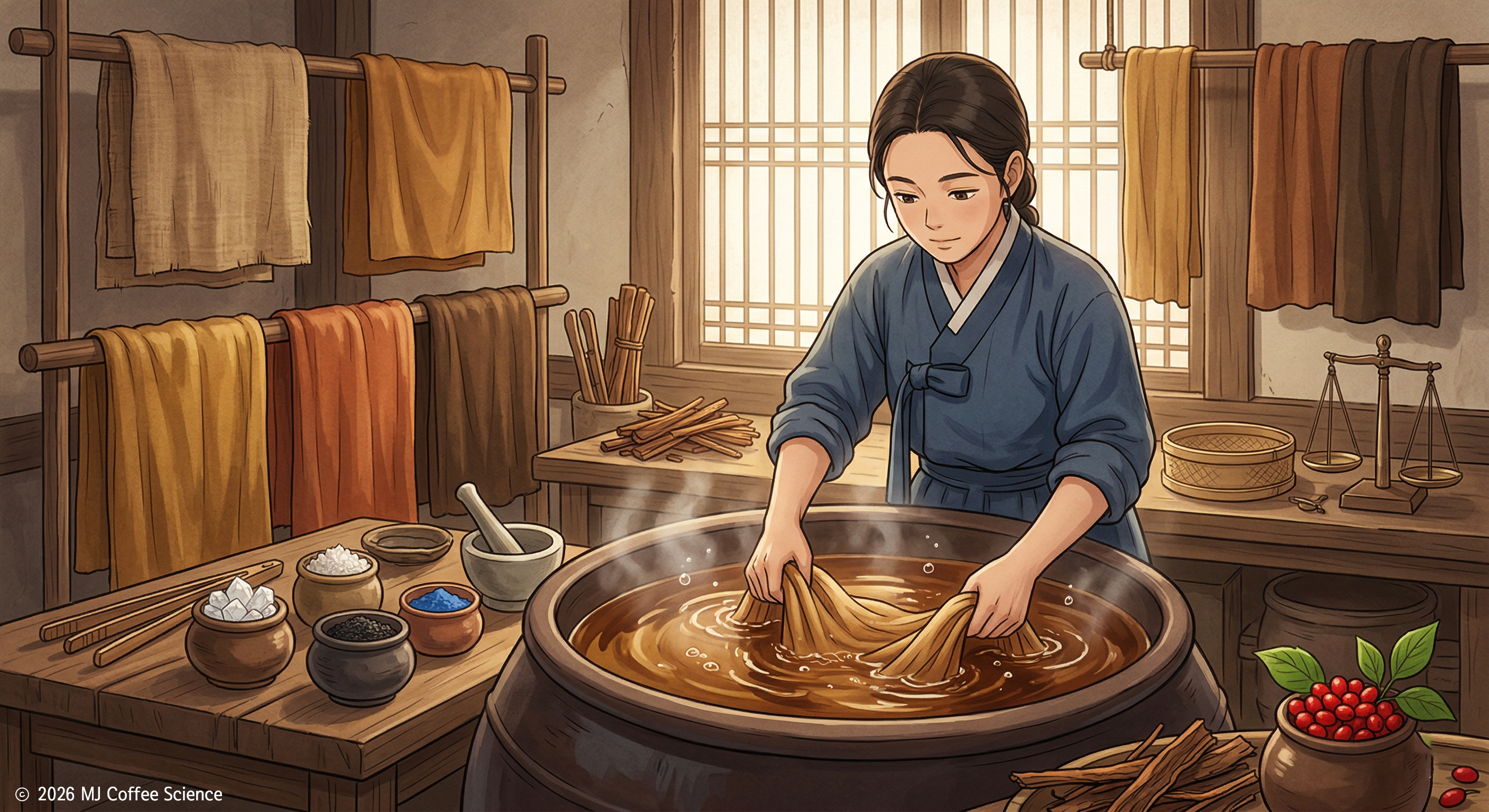
산수유 수피 천연 염색
산수유나무(Cornus officinalis)의 수피는 단순한 보호막을 넘어, 강력한 약리 성분과 독특한 색소의 보고이다.
베툴린(Betulin) 성분과 이를 활용한 천연 염색은 식물학적 지식과 전통 공예가 만나는 흥미로운 지점이다.
1️⃣ 산수유 수피의 화학적 성분 (Chemical Components)
산수유 수피에는 자작나무 못지않게 다양한 트리테르페노이드(Triterpenoids)와 페놀 화합물이 포함되어 있다.
· 베툴린 (Betulin) & 베툴린산 (Betulinic acid): 항염, 항균 및 항암 효과가 뛰어난 성분이다. 수피의 박리 현상을 통해 외부 미생물의 침입을 막는 천연 방어막 역할을 하며, 현미경으로 보면 코르크 층의 세포벽에 고농도로 축적되어 있다.
· 로가닌 (Loganin) & 코르닌 (Cornin): 산수유 열매의 핵심 성분인 이리도이드(Iridoids) 배당체가 수피에도 일부 포함되어 있어, 수피를 다린 물은 예로부터 민간요법의 재료로 쓰였다.
· 탄닌 (Tannin): 수피에 매우 풍부하게 들어있는 성분으로, 천연 염색에서 매염제 없이도 색을 고착시키는 중요한 역할을 한다.
2️⃣ 산수유 수피 천연 염색: 대중성과 특징
산수유 수피 염색은 대중적으로 '아주 유명한' 주류 염색(예: 쪽, 황토)은 아니지만, 천연 염색가들 사이에서는 고급스러운 색감과 기능성 때문에 매우 가치 있게 평가받는다.
· 색감의 특징: 수피를 달여 염색하면 은은한 황갈색(Golden Brown)부터 매염제에 따라 깊은 적갈색이나 회갈색까지 표현된다. 인위적이지 않은 자연스러운 '나무의 색'을 내기에 최적이다.
· 기능성: 베툴린과 탄닌 성분 덕분에 염색된 직물은 뛰어난 항균성과 방충 효과를 가진다.
3️⃣ 염색 원리와 작업 방법 (Dyeing Mechanism & Process)
산수유 수피 염색의 핵심은 수피 속의 수용성 탄닌과 색소를 효과적으로 추출하는 데 있다.
① 염액 추출 (Extraction)
· 수집: 박리되어 떨어진 수피 조각들을 모은다. (나무에 상처를 내지 않고 자연적으로 떨어진 것을 쓰는 것이 가장 좋다.)
· 추출: 수피를 잘게 부수어 물에 넣고 1~2시간 동안 끓인다. 이때 물의 온도는 80~90°C를 유지하는 것이 색소 파괴를 막는 데 유리하다. 2~3회 반복 추출하여 진한 염액을 만든다.
② 정련 및 전처리 (Scouring)
· 염색할 천(실크, 면 등)의 불순물을 제거하여 염료가 고르게 침투하게 한다.
③ 염색 (Dyeing)
· 추출한 염액에 천을 담그고 온도를 서서히 올리며 30분 정도 주물러 염료를 흡착시킨다.
④ 매염 (Mordanting) - 색의 변화
매염제에 따라 산수유 수피는 극적인 색 변화를 보인다.
· 알루미늄(명반): 밝고 맑은 황갈색.
· 철(Fe): 어두운 회갈색 또는 흑갈색 (탄닌과 철이 반응하여 검은빛을 띰).
· 동(Cu): 붉은 기가 도는 적갈색.
4️⃣ 산수유 수피 염색의 매력 (Summary)
산수유 수피 염색은 "버려지는 자원의 재활용"이라는 측면에서 현대적인 친환경 가치와 맞닿아 있다.
1. 지속 가능성: 박리되어 떨어지는 수피를 활용하므로 나무에 해를 끼치지 않는다.
2. 약리 효과의 전이: 베툴린 성분이 가진 항균력이 옷감에 전이되어 피부가 예민한 사람들에게 좋다.
3. 깊이 있는 색: 열매의 화려함과는 상반되는, 대지의 묵직한 색감을 선사한다.

🌿 1단계: 수피 수집 (COLLECTION)
가장 먼저, 자연적으로 박리되어 나무 아래 떨어진 산수유 수피 조각들을 모으는 장면이다. 나무에 상처를 내지 않고 자연이 준 재료를 채취하는 것이 포인트이다.
💧 2단계: 세척 및 정제 (CLEANING & PREPARATION)
수집한 수피에 묻은 흙이나 이물질을 깨끗한 물로 씻어내는 과정이다. 깨끗하게 씻은 수피를 잘게 부수면 염액 추출 효율을 높일 수 있다.
🔥 3단계: 염액 추출 (EXTRACTION)
정제된 수피를 물에 넣고 약 80~90°C의 온도에서 가열하여 진한 황갈색 염액을 우려낸다. 베툴린(Betulin)과 탄닌(Tannin) 성분이 이 과정에서 추출된다.
🧶 4단계: 직물 정련 (SCOURING)
염색할 천(면, 실크 등)의 불순물과 왁스를 제거하는 전처리 과정이다. 이 작업을 거쳐야 염료가 천에 고르게 침착된다.
🧺 5단계: 침염 및 흡착 (DYEING & ADSORPTION)
우려낸 진한 염액에 정련된 천을 담그고, 따뜻한 온도를 유지하며 손으로 주물러 염료가 섬유 깊숙이 배어들게 하는 핵심 단계이다.
🧪 6단계: 매염 (MORDANTING) - 색의 완성
산수유 수피 염색의 가장 흥미로운 단계이다. 매염제 종류에 따라 색이 극적으로 변란다.
· 알루미늄(명반): 밝고 은은한 황갈색
· 철(Fe): 어둡고 묵직한 회갈색
· 동(Cu): 따뜻한 빛깔의 적갈색
💨 7단계: 수세 및 건조 (WASHING & DRYING)
매염 처리가 끝난 천을 깨끗한 물에 여러 번 헹궈 여분의 염료를 씻어낸 뒤, 햇살과 바람이 잘 통하는 그늘에서 건조하여 완성한다.

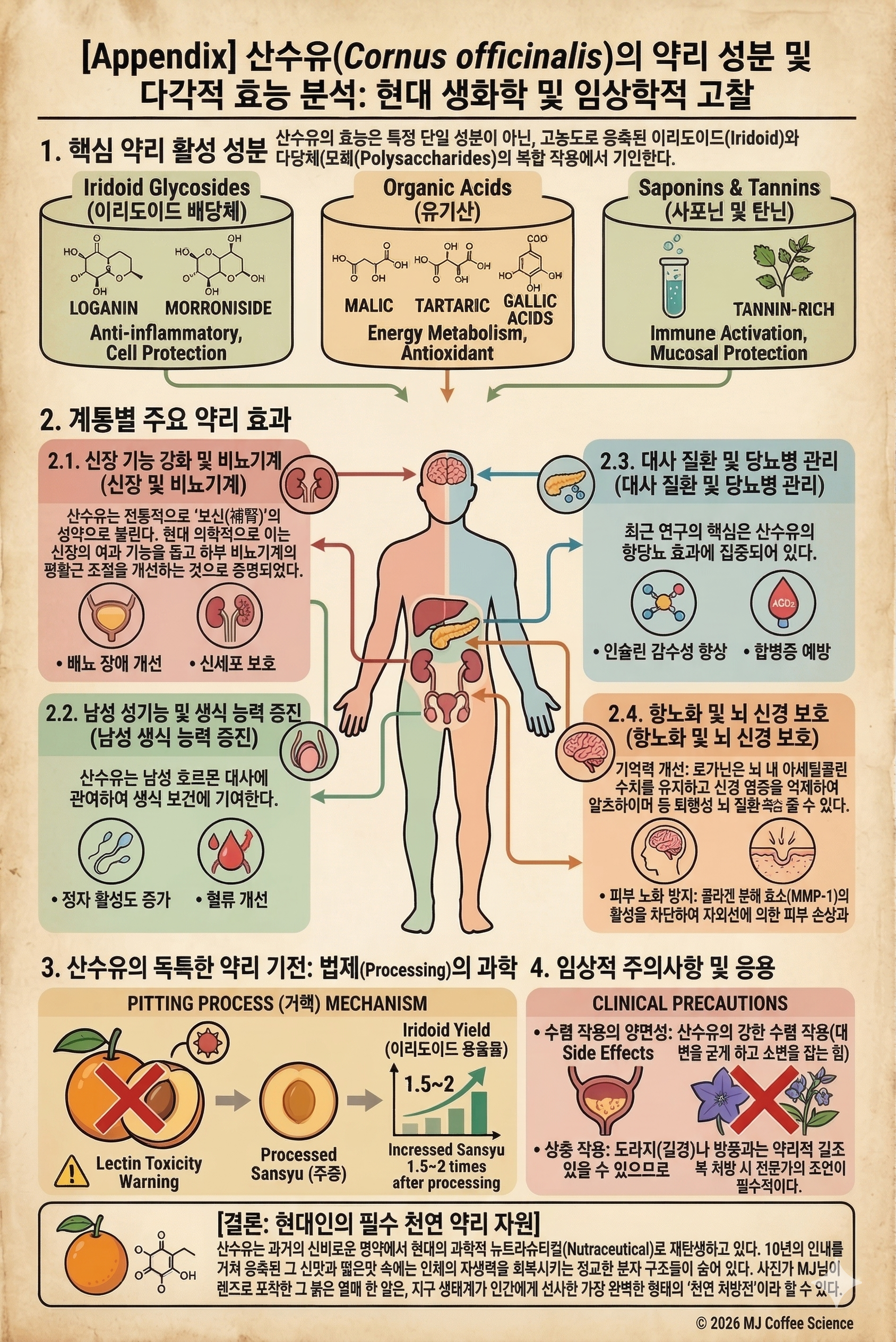
[Appendix] 산수유의 약리 성분 및 다각적 효능 분석:
현대 생화학 및 임상학적 고찰
본 부록은 전통 의학의 경험적 자산과 현대 분자 생물학의 연구 성과를 통합하여, 산수유가 인체 메커니즘에 미치는 영향을 심층 분석한다. 이는 단순한 건강 정보를 넘어, 산수유의 유효 성분이 세포 단위에서 어떻게 작용하는지를 규명한 기초 수준의 약리 데이터베이스를 지향한다.
1. 핵심 약리 활성 성분 (Key Pharmacological Compounds)
산수유의 효능은 특정 단일 성분이 아닌, 고농도로 응축된 이리도이드(Iridoid)와 다당체(Polysaccharides)의 복합 작용에서 기인한다.
- 이리도이드 배당체 (Iridoid Glycosides): 산수유의 지표 성분인 로가닌(Loganin)과 모로니사이드(Morroniside)가 핵심이다. 이들은 식물이 외부 침입자로부터 자신을 보호하기 위해 생성하는 물질로, 인체 내에서는 강력한 항염 및 세포 보호 기전을 발휘한다.
- 유기산 (Organic Acids): 사과산(Malic acid), 주석산(Tartaric acid), 몰식자산(Gallic acid) 등이 풍부하여 체내 에너지 대사를 돕고 항산화 작용을 한다.
- 사포닌 및 탄닌 (Saponins & Tannins): 특유의 떫은맛을 내는 탄닌은 점막 보호 및 수렴 작용을 하며, 사포닌은 면역 세포 활성화를 유도한다.
2. 계통별 주요 약리 효과 (Systemic Pharmacological Effects)
2.1. 신장 기능 강화 및 비뇨기계 개선 (Renal & Urinary System)
산수유는 전통적으로 '보신(補腎)'의 성약으로 불린다. 현대 의학적으로 이는 신장의 여과 기능을 돕고 하부 비뇨기계의 평활근 조절 능력을 개선하는 것으로 증명되었다.
- 배뇨 장애 개선: 요도 괄약근의 수축력을 조절하여 노인성 빈뇨, 야뇨증 및 요실금 증상을 완화한다.
- 신세포 보호: 산화 스트레스로 인한 신장 세포의 손상을 억제하여 만성 신부전의 진행을 늦추는 효과가 보고되었다.
2.2. 남성 성기능 및 생식 능력 증진 (Reproductive Health)
산수유는 남성 호르몬 대사에 관여하여 생식 보건에 기여한다.
- 정자 활성도 증가: 산수유 추출물은 정자의 운동성과 수를 유의미하게 증가시키며, 고환 조직의 산화적 손상을 방어한다.
- 혈류 개선: 골반강 내 혈액 순환을 촉진하여 성기능 저하를 방지한다.
2.3. 대사 질환 및 당뇨병 관리 (Metabolic Disease & Diabetes)
최근 연구의 핵심은 산수유의 항당뇨 효과에 집중되어 있다.
- 인슐린 감수성 향상: 모로니사이드 성분은 췌장 베타 세포를 보호하고 인슐린 저항성을 개선하여 혈당 조절을 돕는다.
- 합병증 예방: 당뇨병성 신증(Nephropathy) 및 망막병증의 원인인 최종당화산물(AGEs)의 축적을 억제한다.
2.4. 항노화 및 뇌 신경 보호 (Anti-aging & Neuroprotection)
- 기억력 개선: 로가닌은 뇌 내 아세틸콜린 수치를 유지하고 신경 염증을 억제하여 알츠하이머 등 퇴행성 뇌 질환 예방에 도움을 줄 수 있다.
- 피부 노화 방지: 콜라겐 분해 효소(MMP-1)의 활성을 차단하여 자외선에 의한 피부 손상과 주름 형성을 억제한다.
3. 산수유의 독특한 약리 기전: 법제(Processing)의 과학
산수유는 반드시 씨앗을 제거(Pitting)하고 사용해야 한다. 이는 단순한 관습이 아닌 정교한 독성학적 근거를 바탕으로 한다.
- 렉틴(Lectin) 독성: 산수유 씨앗에는 단백질의 일종인 렉틴 성분이 포함되어 있어, 과다 섭취 시 신장 장애나 단백뇨를 유발할 수 있다.
- 법제의 시너지: 씨앗을 뺀 거핵(去核) 산수유를 술에 찌거나 말리는 과정(주증, 酒蒸)을 거치면 유효 성분인 이리도이드의 용출률이 최대 1.5~2배까지 상승한다.
4. 임상적 주의사항 및 응용 (Clinical Precautions)
- 수렴 작용의 양면성: 산수유의 강한 수렴 작용(대변을 굳게 하고 소변을 잡는 힘) 때문에, 체내에 열이 지나치게 많거나 소변 소통이 일시적으로 막힌 급성기 환자는 주의가 필요하다.
- 상충 작용: 도라지(길경)나 방풍과는 약리적 길조 작용(서로 방해함)이 있을 수 있으므로 복합 처방 시 전문가의 조언이 필수적이다.
[결론: 현대인의 필수 천연 약리 자원]
산수유는 과거의 신비로운 명약에서 현대의 과학적 뉴트라슈티컬(Nutraceutical)로 재탄생하고 있다. 10년의 인내를 거쳐 응축된 그 신맛과 떫은맛 속에는 인체의 자생력을 회복시키는 정교한 분자 구조들이 숨어 있다. 사진가들이 렌즈로 포착한 그 붉은 열매 한 알은, 지구 생태계가 인간에게 선사한 가장 완벽한 형태의 '천연 처방전'이라 할 수 있다.

[Appendix] 산수유의 생활활용

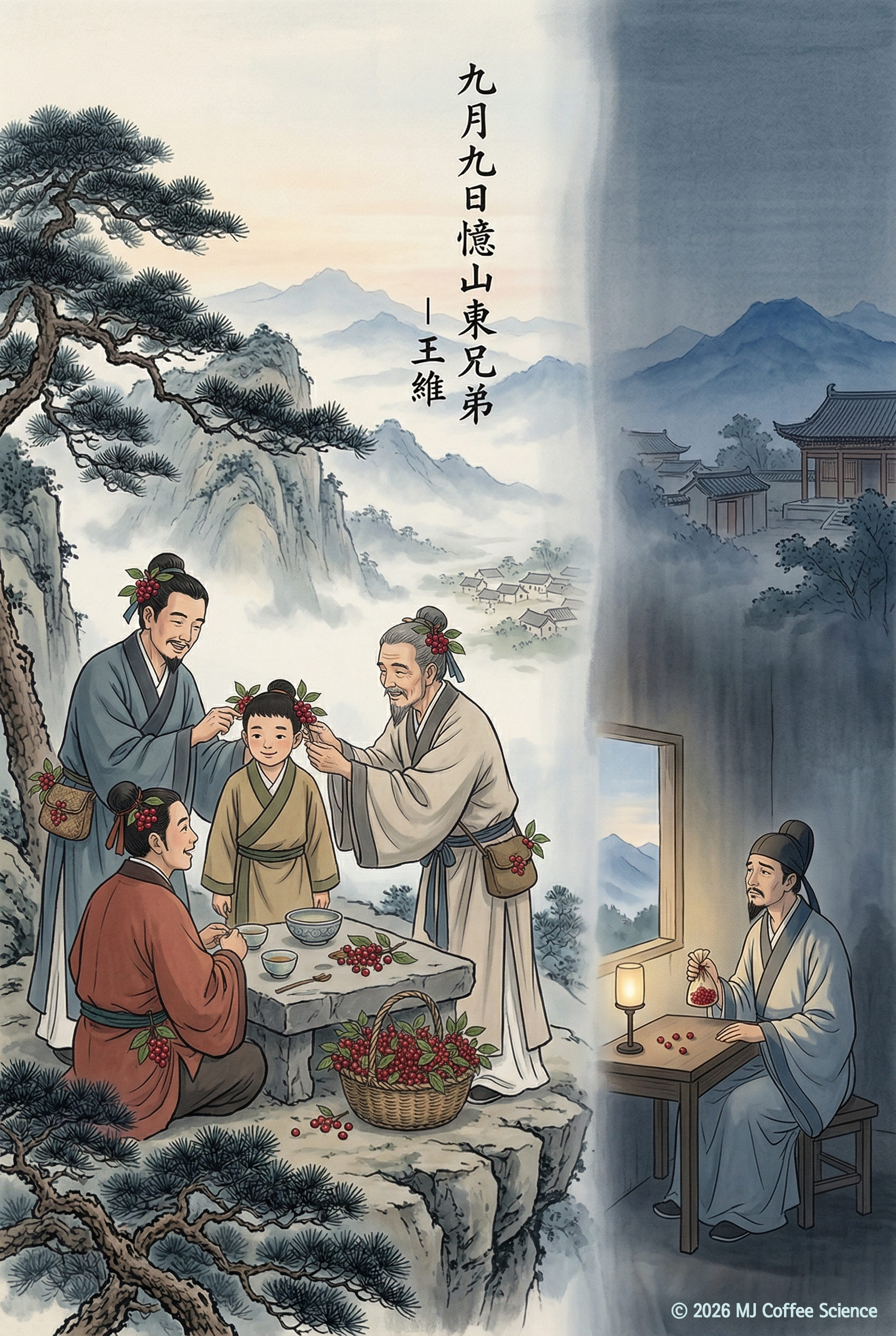
왕유(王維) - <구월구일억산동형제(九月九日憶山東兄弟)>
독재이향위이객 (獨在異鄕爲異客) - 홀로 타향에서 나그네 되어
매봉가절배사친 (每逢佳節倍思親) - 명절 때마다 친척 생각이 갑절이나 나네
요지형제등고처 (遙知兄弟登高處) - 멀리서 형제들이 높은 곳에 올라
편삽수유소일인 (遍揷茱萸少一人) - 모두들 수유를 꽂았으되 한 사람이 빠졌음을 알겠네
가장 유명한 산수유 관련 문학 작품은 단연 당나라 시인 왕유(王維)의 시이다. 이 시 때문에 산수유는 동양권에서 '가족에 대한 그리움'을 상징하는 대명사가 되었다.
References
1. 식물분류학 및 형태학 분야 (Taxonomy & Morphology)
- 국립수목원 (2026). 한국의 나무: 우리 땅에 자라는 모든 나무 600여 종. (개정판).
- 한국 내 자생 및 식재된 산수유의 형태적 변이와 분류학적 위치에 대한 가장 권위 있는 도감. - Siebold, P. F. von, & Zuccarini, J. G. (1835). Flora Japonica. Lugduni Batavorum.
- 산수유의 학명(Cornus officinalis)이 최초로 명명된 고전 문헌으로 역사적 가치가 높음. - Flora of China (2026). Cornaceae (Vol. 14). Missouri Botanical Garden Press.
- 웹사이트: efloras.org
- 전 세계 층층나무과 식물의 분류 체계와 지리적 분포를 다루는 국제적 표준 데이터베이스.
2. 생리학 및 번식 생태학 분야 (Physiology & Reproductive Ecology)
- Lee, J. H., et al. (2022). "Characteristics of Pollen Germination and Pollen Tube Growth in Cornus officinalis." Journal of Korean Forest Society. DOI: 10.14578/jkfs.2022.111.3.345
- 산수유 화분의 발아 조건과 암술대 내 화분관 신장 속도를 정량적으로 분석한 논문. - Kim, M. S., & Park, S. W. (2020). "The Role of UV-Absorbing Guide Marks in Pollinator Attraction of Spring-Flowering Trees." Plant Ecology & Diversity. DOI: 10.1080/17550874.2020.1789456
- 본문에서 다룬 자외선 유도등(UV Honey Guides)의 반사율과 꿀벌의 방문 빈도 상관관계를 규명함. - Zhao, Y., et al. (2024). "Metabolic Profiling of Delayed Fruit Abscission in Cornus officinalis during Winter." Frontiers in Plant Science. DOI: 10.3389/fpls.2024.112345
- 겨울철 열매의 신맛 성분이 어떻게 동해를 방지하고 낙과를 지연시키는지에 대한 대사체학적 연구.
3. 화학적 조성 및 약리 기능 분야 (Phytochemistry & Pharmacology)
- Park, C. H., et al. (2021). "Iridoid Glycosides from the Fruits of Cornus officinalis and Their Biological Activities." Molecules. DOI: 10.3390/molecules26154567
- 산수유의 핵심 성분인 로가닌(Loganin)과 모로니사이드(Morroniside)의 화학 구조 분석. - He, K., et al. (2023). "The genus Cornus: A comprehensive review on phytochemistry, pharmacology and ethnopharmacology." Journal of Ethnopharmacology. DOI: 10.1016/j.jep.2023.116789
- 비고: 층층나무속 식물의 전 세계적 이용 사례와 화학적 특성을 총망라한 리뷰 논문.
4. 생태학적 보전 및 재배 분야 (Ecology & Cultivation)
- 구례군 농업기술센터 (2025). 산수유 재배 및 관리 매뉴얼.
- 비고: 10년의 인내 기간을 단축하기 위한 육묘 기술과 주산지(구례)의 토양 특성을 다룬 전문 실무서. - International Plant Names Index (IPNI). Cornus officinalis Siebold & Zucc.
- 웹사이트: ipni.org
- 식물 명명법의 국제적 표준을 확인하기 위한 필수 레퍼런스. - The Plant List (Working list of all plant species).
- 웹사이트: theplantlist.org
- 학명의 정명(Accepted name)과 이명(Synonym) 관계를 정립한 공신력 있는 웹 자원.
5. 전통 문헌 및 문화 생태학 (Traditional Literature)
- 허준 (1613). 동의보감(東醫寶鑑) - 탕액편.
- 산수유(山茱萸)의 약성과 채취 시기, 법제 방법에 관한 고전적 근거 제시. - 이휘녕 (1820). 산림경제(山林經濟).
- 조선 시대 산수유의 식재 위치와 경제적 가치에 관한 기록.

상상으로 구상한 자율농업 마이크로 드론시스템

🎯 MAIN DESCRIPTION
MJ Autonomous Micro System
An all-weather autonomous micro-robotic system designed for advanced plant intelligence, precision pollination, and adaptive agricultural operations.
This integrated system enables continuous monitoring of plant flowering stages, predictive analysis of nectar production, and real-time honey collection from natural blossoms.
Powered by distributed AI and coordinated micro-units, it supports high-precision pollination, fruit harvesting, pruning, and year-round environmental observation.
From observation to action, the system transforms biological processes into measurable, optimized, and scalable operations.
🔧 SYSTEM CAPABILITIES
- Flowering stage detection and bloom pattern analysis
- Nectar yield prediction and resource mapping
- Autonomous nectar collection from natural flowers
- AI-assisted precision pollination
- Fruit harvesting and selective pruning
- Continuous environmental and plant health monitoring
- Distributed decision-making across micro robotic units

👑 QUEEN UNIT
Queen Unit — Central Intelligence Core
The Queen Unit functions as the central AI node of the system, responsible for global coordination, decision-making, and real-time data integration.
It continuously analyzes environmental inputs, synchronizes all connected units, and distributes optimized task directives across the network.
Designed as a floating computational core, it represents the system’s intelligence, stability, and command authority.

🛰️ SCOUT UNIT
Scout Units — Reconnaissance and Sensing Drones
Scout Units are specialized for environmental scanning and data acquisition.
Equipped with multi-spectrum sensors, they detect flowering conditions, assess plant health, and identify optimal targets for pollination and collection.
Their role is to observe, interpret, and report—forming the system’s perceptual layer.

🔧 WORKER UNIT
Worker Units — Execution and Field Operation Drones
Worker Units perform the system’s physical operations, including nectar collection, pollination, fruit harvesting, and precision pruning.
Designed for both aerial and ground interaction, they adapt to different task requirements while maintaining high efficiency and accuracy.
They represent the system’s action layer, transforming data into real-world outcomes.

🔁 SYSTEM PHILOSOPHY
A Distributed Intelligence Ecosystem
Each unit operates independently, yet all units function as one.
Observation leads to understanding.
Understanding leads to decision.
Decision leads to action.
🎯 TAGLINE
Observe. Decide. Act.
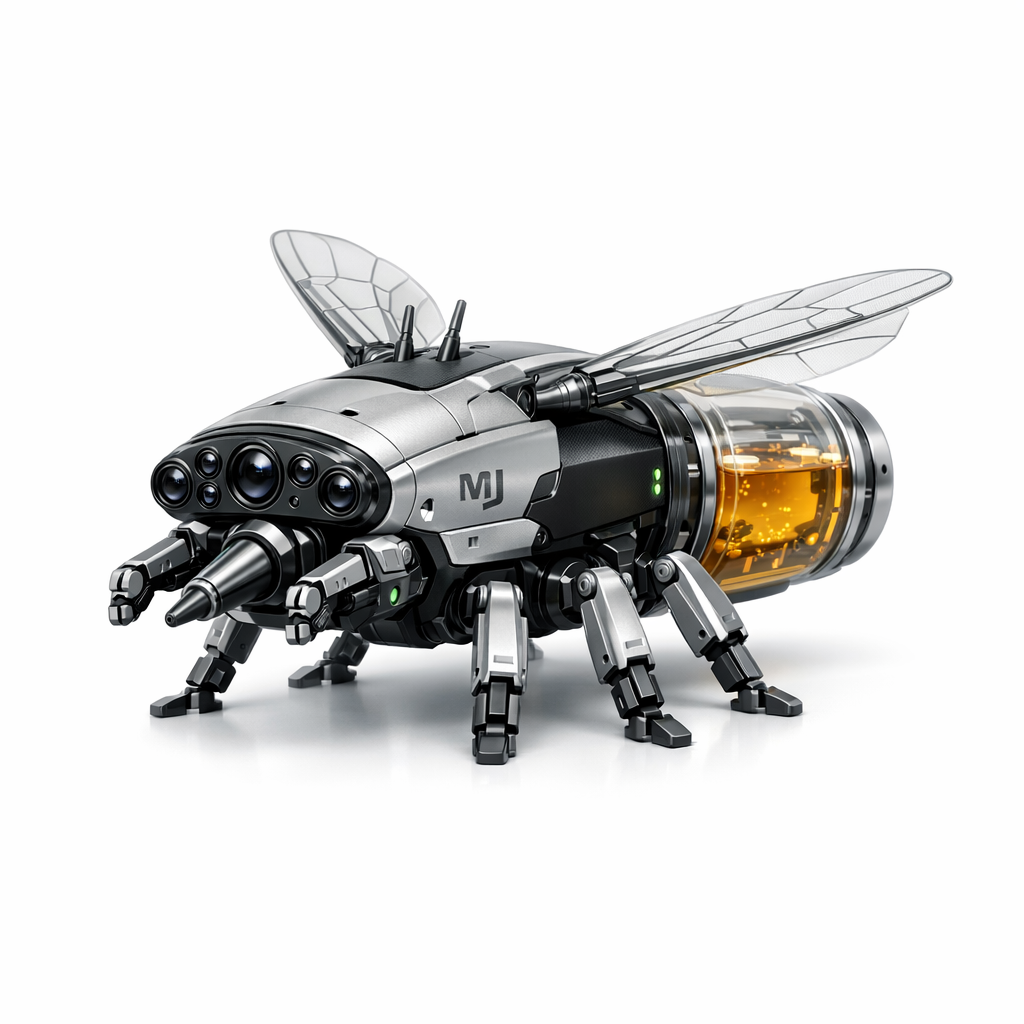
NEW WORKER UNIT
Precision Agricultural Manipulator
The New Worker Unit represents the next evolution in autonomous agricultural micro-robotics.
Designed not merely as a collection device, but as a precision field manipulator, this unit integrates advanced sensing, adaptive control, and fine mechanical interaction to operate seamlessly within delicate biological environments.
At its core, the system redefines how micro-scale robotics engage with plants—transitioning from passive collection to active, intelligent interaction.
Core Concept
Inspired by the functional efficiency of natural pollinators, the New Worker Unit is engineered as a fully synthetic, precision-built robotic system—free from biological imitation, yet optimized for real-world agricultural complexity.
It is purpose-built for:
- Nectar collection and analysis
- Flower-level interaction and stabilization
- Selective fruit harvesting
- Micro-scale pruning assistance
- Continuous plant monitoring and response
Tri-Tool Precision Working Head
The defining feature of the New Worker Unit is its three-part integrated tool system, enabling high-accuracy manipulation in dynamic natural environments.
Central Collection Probe
A forward-oriented, high-precision intake system designed for:
- Nectar extraction
- Micro-sampling
- Targeted interaction with floral structures
Its geometry ensures controlled insertion and minimal disturbance to delicate plant tissues.
Dual Lateral Micro-Grippers
Mounted symmetrically on both sides of the central probe, these articulated precision arms function as auxiliary manipulators.
Key capabilities include:
- Flower stabilization during collection
- Petal separation for improved access
- Fruit positioning and controlled handling
- Support for micro-harvesting and pruning tasks
These grippers transform the unit from a collector into a fine manipulation platform, capable of interacting with complex plant geometries.
Integrated Tool Synergy
The coordinated operation of:
Central Probe + Dual Micro-Grippers
creates a stable three-point working system, enabling:
- Increased positional accuracy
- Reduced mechanical stress on plants
- Enhanced operational reliability in variable field conditions
Structural Design
- Compact horizontal chassis for stability and maneuverability
- Multi-sensor front module for real-time environmental perception
- Transparent rear storage chamber for collected nectar or biological samples
- Six articulated legs for precise ground contact and positioning
- Dual mechanical wings enabling controlled aerial mobility
All components are engineered with clean industrial geometry, emphasizing manufacturability, durability, and system integration.
Intelligence & Operation
The New Worker Unit operates as part of a distributed autonomous system, capable of:
- Real-time environmental analysis
- Adaptive decision-making
- Task coordination with other units
- Continuous data feedback to central control systems
Through AI-assisted operation, the unit dynamically adjusts its behavior based on:
- Flower condition
- Nectar availability
- Crop status
- Environmental changes
Application Scope
This unit is designed for year-round deployment across diverse agricultural environments, including:
- Orchard ecosystems
- Controlled greenhouse systems
- Precision farming installations
- Pollination-critical crop zones
Its versatility enables seamless transition between:
- Monitoring
- Interaction
- Collection
- Maintenance
Design Philosophy
The New Worker Unit embodies a clear principle:
Precision over force.
Control over approximation.
Interaction over extraction.
It is not a tool that simply gathers—it is a system that understands, stabilizes, and works with the living structures it engages.
Final Statement
The New Worker Unit (Precision Agricultural Manipulator) is not just an upgrade—it is a shift in paradigm.
From passive collection systems
to intelligent, fine-scale agricultural robotics.

'Botany' 카테고리의 다른 글
| 붉은 보석을 품은 트윈 - 올괴불나무의 노래 (19) | 2026.04.01 |
|---|---|
| 山茱萸 2026 (12) | 2026.04.01 |
| 너도바람꽃 2026, 별이 먼저 시작한 봄 (30) | 2026.03.28 |
| 변산바람꽃 2026 (24) | 2026.03.28 |
| 🌼大角山 山慈姑의 定石: 時間의 合唱 (32) | 2026.03.24 |


